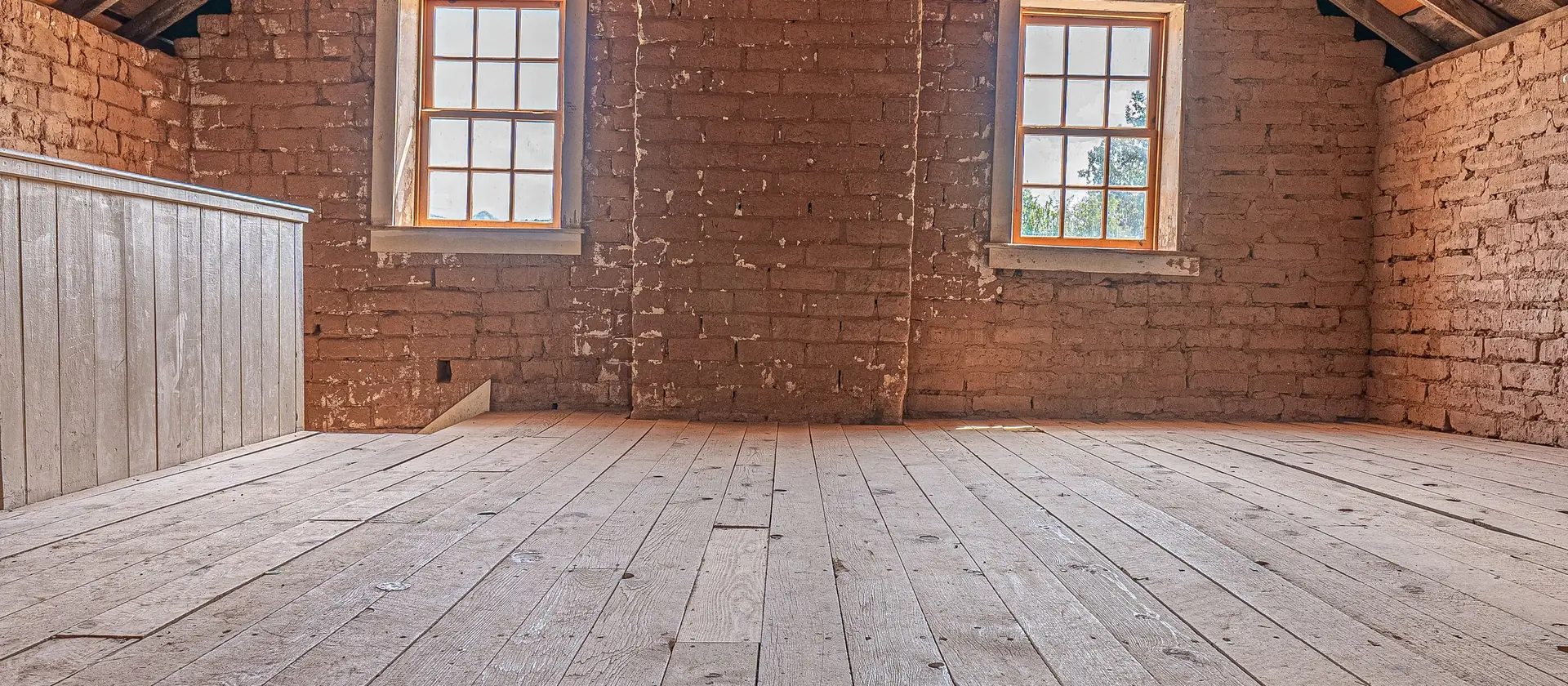
Loft boarding across Cambridgeshire
A proper floor in the roof space you are already paying for, fitted on raised legs so the insulation underneath keeps doing its job. Free survey, a written price before anyone starts, and every exclusion listed in it. Doing the insulation at the same time is one visit instead of two.
The difference is what the boards sit on
The quickest way to board a loft is to screw the boards straight onto the joists. It is what most quotes are for, and it quietly undoes the insulation you already paid for.
Boards straight onto the joists
100mmYour insulation gets crushed to roughly the depth of the timber, the eaves stop breathing, and moisture ends up on the cold side of the roof.
Boards on raised legs, how we do it
270mmLegs stand on the joists and lift the floor clear of the full depth. The insulation keeps working, the eaves keep their airflow, and you still get a floor you can walk on.
That is why we quote the raised system as standard rather than as an upgrade, and why we will tell you if your loft does not need it. If you want the detail, we have written up what causes loft condensation and how to tell whether your loft is strong enough. Can you board over loft insulation?
What happens on the day
-
We measure and set out
Joist depth and spacing, the insulation you already have, the hatch, and where the head height runs out. The boarded area is marked out before anything is cut.
-
Legs and frame go down
Legs stand on the joists and carry a frame above the insulation. Nothing is compressed, and the eaves are left open so air can still move through the roof.
-
The floor goes on
Boards are cut around the trusses, pipework and cables rather than over them, and fixed down so the floor stays flat and quiet underfoot.
-
We clear up and show you
We sheet the landing, take our waste with us, and walk you up to see it. Most lofts are a day, and the ones that are not are usually big, awkward or full.
What changes the price
Four things move a loft boarding quote more than anything else. All four are checked at the survey, and all four are on the written price.
-
Area
How much you board
Boarding the useful middle costs less than chasing the floor out to the eaves, where the head height has gone anyway.
-
Time
What is up there now
Old insulation to lift, a water tank in the way, or a loft full of boxes all add time before a single board goes down.
-
Access
Access
A small or awkward hatch slows everything, because every board and every leg has to go up through it. Enlarging it, or fitting a ladder, is quoted on its own.
-
Condition
The ceiling below
Downlights, cables and pipework need working around properly, and older joists sometimes need looking at before they carry a floor.
What is not included, said out loud
This is where a loft job grows. Each of these is priced on its own line of your quote, so you can say yes or no to it before we start, rather than hearing about it halfway through the day.
Enlarging the hatch
Plenty of older hatches are too small for a ladder or for full sized boards. Making the opening bigger is joinery and plastering.
A new ladder
Boarding gives you the floor. Getting up to it safely is a separate job, and the right ladder depends on the hatch and the landing.
Clearing and disposal
We can clear the loft first and take the contents away, including old insulation, which has to be bagged and disposed of properly.
Topping up the insulation
If what is up there is thin or patchy we will say so and price the top up. Boarding over poor insulation just hides it.
Electrical work
Lighting, sockets and anything to do with downlights is an electrician's job.
Strengthening joists
Rare, and only when the survey says so. Ceiling joists are sized to hold a ceiling, not a loaded floor.
Nothing here is a surprise charge. If your loft needs one of these, it is on the quote before you decide, with a price next to it.
Cambridgeshire lofts, and what the certificates say
29,189 houses and bungalows across our six councils have "Increase loft insulation to 270 mm" written on their Energy Performance Certificate by an independent assessor.
That is the state of each home when it was assessed, so some will have been done since. It is still the clearest picture anyone has of how many local lofts are under insulated, and it is the reason we lift the floor clear of the quilt instead of flattening it. You can look up what your own certificate says, or read the towns we work in for Cambridge, Huntingdon, St Neots, Ely and Peterborough. Source: Energy Performance of Buildings Register, bulk domestic data, analysed September 2026.
Loft boarding questions we get asked
Can you board over loft insulation?
Yes, and it is the right way to do it, as long as the floor is raised clear of the insulation rather than pressed onto it. The longer answer is here. Boards fixed flat to the joists squash the quilt down to the depth of the timber, which is about 100mm in most houses against the 270mm a loft is meant to have.
Will boarding cause condensation?
It can, if the eaves get blocked or the insulation is crushed, because warm damp air then meets a cold roof with nowhere to go. A raised floor keeps the airflow at the eaves and keeps the insulation at full depth, which is why we fit it that way as standard.
Is my loft strong enough to board?
Most are, for storage. Ceiling joists are sized to hold a ceiling rather than a floor, so the survey checks the span, depth and spacing before we quote. If yours needs strengthening we will say so, price it separately, and you can decide.
How much of the loft should I board?
Usually the middle. Head height runs out towards the eaves, so a floor out to the edges costs more and gets used less. We mark out the useful area at the survey and price that, and you can add to it if you want.
What can I keep up there once it is boarded?
A boarded loft is storage, not a room. Suitcases, boxes, decorations, camping gear and the things that come down twice a year, and there is a fuller list here. Weight matters more than space, so we will tell you at the survey what your ceiling will take and how to spread it.
Do I need to empty the loft first?
It helps, but it is not a problem if you cannot. We can clear it as part of the job and take away anything you no longer want, including old insulation. That is priced separately so you can see what it costs.
What about downlights in the ceiling below?
They need room to breathe and must not be covered by insulation or boards. We work around them, and if the safe fix needs an electrician we will tell you rather than quietly boarding over the problem.
Do I need planning permission to board a loft?
No. Putting a storage floor in an existing loft is not a conversion and does not change the use of the space. Turning it into a room is a loft conversion, which is a bigger job with its own rules, and we can sort that for you too.
What if there is spray foam up there?
Then we deal with that first. Spray foam on the roof affects surveys and mortgages, so we look at it, tell you whether it genuinely needs to come out, take it out if it does, and then insulate and board the loft properly.
If the insulation needs doing too
The cheapest time to sort the insulation is while the loft is open and the floor is not down yet. One visit, one lot of mess, and the boards go on top of a loft that is finally at full depth. There are case studies, what we guarantee, and what it costs.
Book a free survey this week
It takes about twenty minutes and you get a written price with nothing hidden in it. If the job is not worth doing, we will tell you that too.